 USD - ($)
  EUR - (€)
  GBP - (£)
  CHF - (CHF)
  SEK - (kr)
  NOK - (kr)
  DKK - (kr.)
  CZK - (Kč)
  PLN - (zł)
  HUF - (Ft)
  RON - (lei)
  UAH - (₴)
  TRY - (₺)



RABIES Test for Dogs and Cats – Canine / Feline RABV Antigen Home Test Kit – LFIA
Price range: $104.00 through $520.00
Free shipping on ALL orders from US!
- Satisfaction Guaranteed
- Easy Refunds
- Secure Payments

Hassle-Free Door-to-Door Global Shipping
Customs Clearance Included



This test requires pet’s saliva or cerebrospinal fluid sample.
You will need one swab of sample.
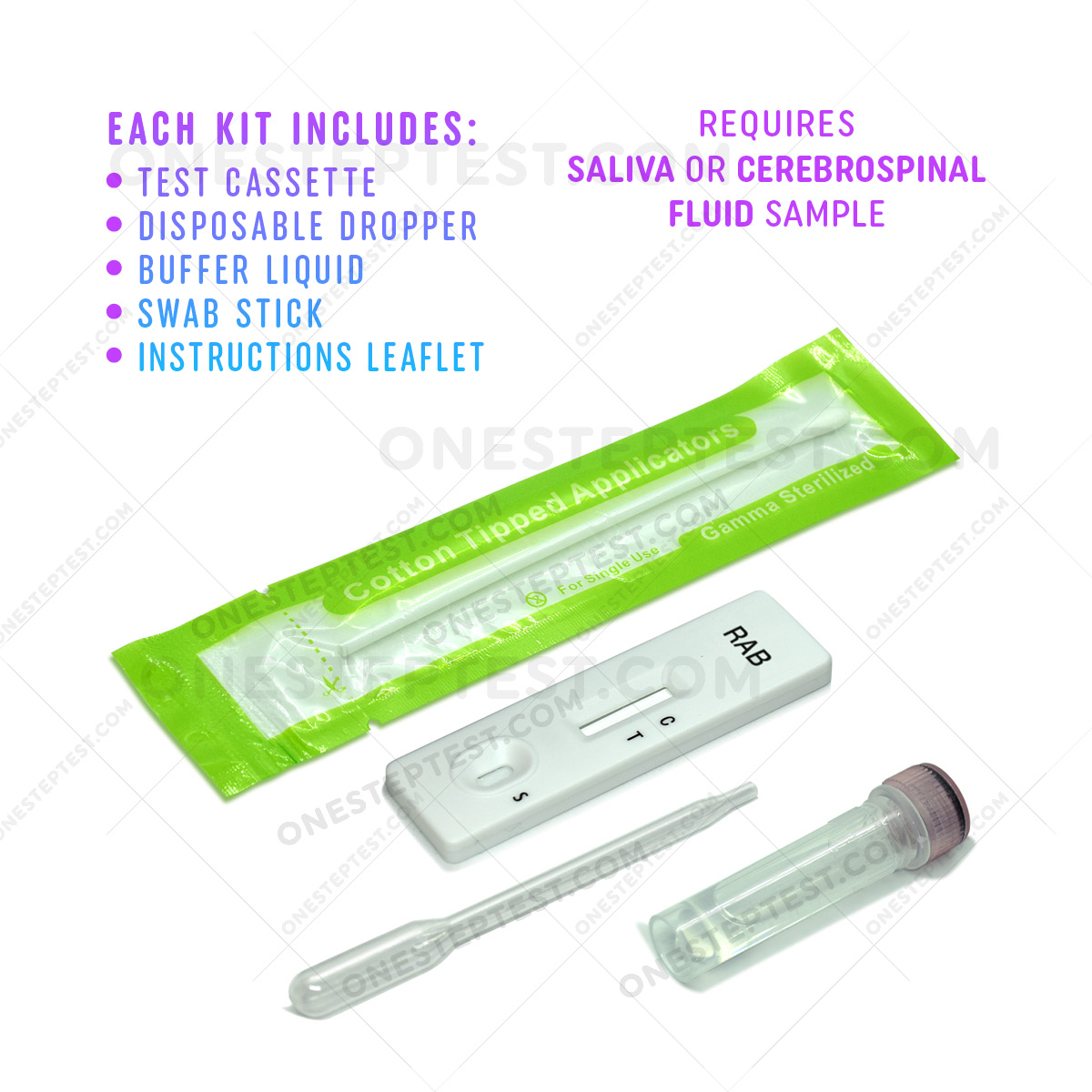
Each kit contains:
- Test cassette
- Disposable dropper
- Buffer liquid tubes
- Cotton swab stick
- Instructions Leaflet (one for every 10 tests)
- Color box packaging (one for every 10 tests)
WHAT YOU WILL RECEIVE:
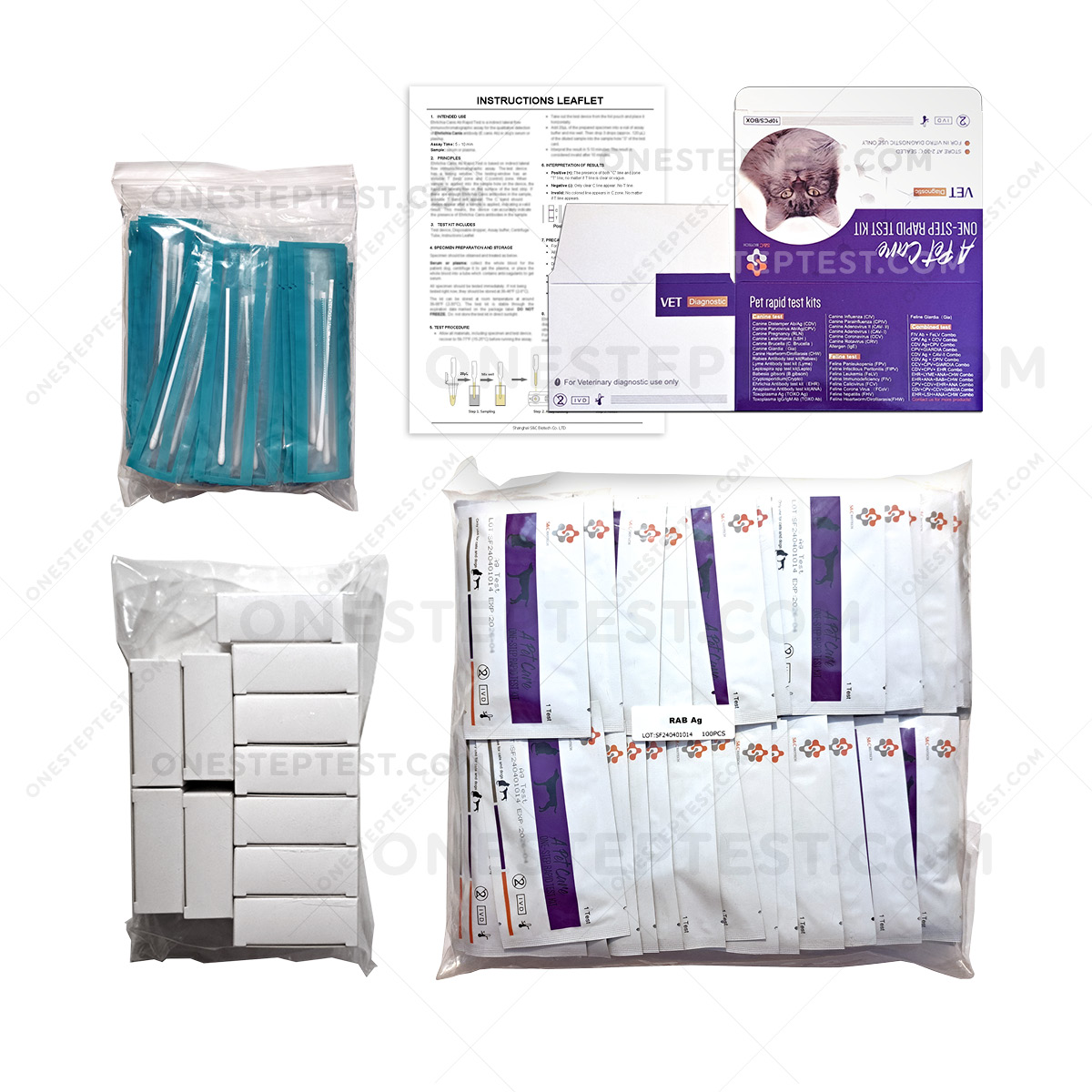
100-pack includes:
– 100 sealed test cassettes
– 100 disposable droppers (inside the sealed cassette pouch)
– 100 buffer liquid tubes (packed in boxes of 10)
– 100 swab sticks (packed in pouches of 10)
– 10 instruction leaflets (one for every 10 tests)
– 10 color box packages (one for every 10 tests)
50-pack includes:
– 50 sealed test cassettes
– 50 disposable droppers (inside the sealed cassette pouch)
– 50 buffer liquid tubes (packed in boxes of 10)
– 50 swab sticks (packed in pouches of 10)
– 5 instruction leaflets (one for every 10 tests)
– 5 color box packages (one for every 10 tests)
20-pack includes:
– 20 sealed test cassettes
– 20 disposable droppers (inside the sealed cassette pouch)
– 20 buffer liquid tubes (packed in boxes of 10)
– 20 swab sticks (packed in pouches of 10)
– 2 instruction leaflets (one for every 10 tests)
– 2 color box packages (one for every 10 tests)
This is a COMPLETE test. No additional equipment is needed—everything required is included in the test kit.
- Read the instructions carefully before starting the test.
- Collect pet’s saliva sample with the cotton swab. Vets can use cerebrospinal fluid. Make the swab sufficiently wet.
Once the sample is ready the RABV test takes 10–15 minutes to complete. - Prepare the test: Remove the test cassette from the foil pouch and place it on a flat surface.
- Insert the swab stick into the tube containing the buffer liquid and mix thoroughly to ensure proper sample extraction. Then use enclosed dropper to transfer 3 drops of the sample mixture into the S (sample) window of the test cassette.
- Wait 5–10 minutes and read the results.
The test is valid for 18 months or more from the date of purchase.
| Test Type | Relative Sensitivity | Relative Specificity | Relative Accuracy |
|---|---|---|---|
| Rabies Virus Antigen Test (RABV): | 97.8% | 100% | 98.8% |
What is Rabies?
Rabies is a deadly viral disease that attacks the brain and nervous system of mammals, including cats, dogs, and humans. It is caused by a virus in the genus Lyssavirus. Once clinical signs appear, rabies is almost 100% fatal. This is why vaccination is so important.
What Makes Rabies Different from Other Diseases?
Unlike most other infectious diseases, rabies has two unique and terrifying features:
-
It is always fatal once symptoms begin. There is no cure.
-
It can spread from animals to humans (a zoonotic disease). Human rabies is also almost always fatal without immediate post-exposure treatment.
Because of this, rabies is a major public health concern worldwide.
Where is Rabies Found?
Rabies is found on every continent except Antarctica. Some countries and regions are considered “rabies-free” (e.g., islands like Hawaii, Great Britain, Japan, Australia, New Zealand), but most of the world, including the Americas, Europe, Asia, and Africa, has rabies present in wildlife or domestic animals.
Reservoirs (animals that carry rabies) vary by region:
| Region | Common Wildlife Reservoirs |
|---|---|
| North America | Raccoons, skunks, bats, foxes |
| Europe | Foxes, bats |
| Asia | Dogs (stray populations), bats |
| Africa | Dogs, mongooses, bats |
| South America | Bats, dogs |
Key point: In many parts of the world, dogs are the main source of rabies transmission to humans.
How Do Cats and Dogs Get Infected?
Rabies is spread through the saliva of an infected animal. The virus enters the body through a bite wound, scratch, or contact with mucous membranes (eyes, nose, mouth).
Most common routes:
| Route | How It Happens |
|---|---|
| Bite wound | An infected animal bites your pet (MOST common) |
| Scratch | An infected animal scratches your pet (less common, but saliva on claws can transmit) |
| Mucous membrane contact | Saliva gets into eyes, nose, or mouth |
| Open wound contact | Saliva enters a fresh cut or wound |
Sources of infection for pets:
-
Wildlife (raccoons, skunks, foxes, bats)
-
Stray dogs or cats
-
Unvaccinated domestic animals
Key point: A dog or cat does NOT need to be bitten by a “raging, foaming” animal. Any bite from any wild or unvaccinated animal is a potential rabies exposure.
Clinical Signs in Cats and Dogs
The time from infection to symptoms (incubation period) is highly variable, ranging from weeks to months. Once symptoms begin, the disease progresses rapidly, usually causing death within 7–10 days.
There are two main forms of rabies:
1. FURIOUS RABIES (more common in dogs)
This form is what most people imagine: aggressive, “mad” animals.
Signs in dogs and cats:
-
Restlessness and anxiety
-
Aggression (biting, snapping at anything, including owners)
-
Irritability
-
Pica (eating non-food items like rocks, dirt, wood)
-
Disorientation and wandering
-
Seizures
-
Hydrophobia (fear of water – rare in animals, more common in humans)
-
Death from respiratory failure
2. PARALYTIC (DUMB) RABIES (more common in cats)
This form is quieter but just as deadly. The animal becomes paralyzed.
Signs in dogs and cats:
-
Weakness, starting in the hind legs
-
Dropping of the lower jaw (looks like something stuck in the mouth)
-
Drooling or foaming at the mouth (inability to swallow)
-
Change in voice (hoarse bark or meow)
-
Progressive paralysis
-
Coma followed by death
Important: Both forms eventually progress to paralysis and death.
Early, subtle signs (often missed):
-
Sudden change in behavior (friendly dog becomes shy, shy cat becomes friendly)
-
Licking or biting at the site of the bite wound
-
Fever (early, then disappears)
-
Nocturnal animals (bats, foxes) out during the day
Key point: Any sudden, unexplained change in behavior in a dog or cat should raise suspicion for rabies, especially if the animal is not vaccinated or has unknown vaccine history.
Diagnosis
There is no reliable live-animal test for rabies. The only definitive test requires examination of brain tissue after the animal has died.
In a living animal:
-
Diagnosis is based on clinical signs and exposure history
-
No blood or saliva test is reliable enough to rule out rabies
After death:
-
Direct Fluorescent Antibody (DFA) test on brain tissue – this is the gold standard
-
Results are usually available within hours
What this means for veterinarians: If a dog or cat shows signs of rabies, it must be euthanized and tested. There is no “wait and see” approach because of the public health risk.
Prognosis (Outlook)
| Stage | Prognosis |
|---|---|
| After exposure (before symptoms) | Good – with immediate post-exposure vaccination and observation |
| After clinical signs appear | 100% fatal – no treatment, no cure |
Key clinical reality: Once a dog or cat shows signs of rabies, euthanasia is recommended immediately for humane reasons and to protect human health. There is no treatment.
Prevention (Vaccination)
Rabies is entirely preventable through vaccination. This is the single most important thing you can do for your patients and for public health.
Vaccination recommendations:
| Animal | Recommendation |
|---|---|
| Dogs | First vaccine at 12–16 weeks, booster at 1 year, then every 1–3 years depending on local laws and vaccine type |
| Cats | Same schedule as dogs (indoor cats should also be vaccinated – bats can get inside) |
Why vaccinate indoor cats? Bats can enter homes. An indoor cat that catches a bat is at risk for rabies exposure.
Legal requirements: In most of the United States and many other countries, rabies vaccination is required by law for dogs and often for cats.
What to Do After a Potential Exposure
If a dog or cat is bitten by a wild animal or an unvaccinated animal:
| Situation | Action |
|---|---|
| Vaccinated animal (up-to-date) | Booster vaccine immediately + 45-day observation at home |
| Unvaccinated animal | Euthanasia and testing OR strict 4-6 month quarantine (no human contact, no outdoor access) |
| Animal that bit a human | 10-day observation period (if alive after 10 days, no rabies at time of bite) |
Key point: Any animal that bites a human must be quarantined for 10 days and observed for signs of rabies.
Public Health Importance
Rabies is a reportable disease everywhere. If you suspect rabies:
-
Protect yourself – wear gloves, mask, eye protection
-
Isolate the animal immediately
-
Contact public health authorities – they will guide next steps
-
Euthanize and test if rabies is strongly suspected
-
Notify any exposed humans – they need immediate post-exposure prophylaxis (PEP), which includes rabies vaccine and immune globulin
Human rabies is almost always fatal once symptoms start. This is why we take every potential exposure seriously.
Key Takeaways for Practice
-
Rabies is 100% fatal once symptoms appear. There is no treatment.
-
Vaccination is the only prevention. This is a legal requirement in many places and a public health necessity.
-
Any sudden behavior change in an unvaccinated animal is a red flag.
-
There is no reliable live-animal test. Diagnosis requires brain tissue after death.
-
Protect yourself. Wear gloves and eye protection when handling any animal with neurologic signs.
-
Report suspected rabies to public health authorities immediately.
-
Quarantine and observe any animal that bites a human.
Description
Rabies Test for Dogs and Cats – Lateral Flow Test (LFIA)
Canine / Feline RABV Test At-Home – Rabies Virus Testing Kit for Dogs and Cats
A-PET-CARE One Step Canine / Feline Rabies Antigen Detection – Home Testing Kit for RABV
The tests do NOT come pre-packed in boxes; they come disassembled (see product pictures for details).
EXP. DATE: 18 months or more from the date of purchase
Each kit includes:
– Test cassette
– Disposable Dropper
– Buffer Liquid
– Swab Stick
– Instructions Leaflet (one for every 10 tests)
– Color box packaging (one for every 10 tests)
A-PET-CARE One Step Rabies test for dogs and cats can be performed at home.
This pet Rabies virus – RABV home test works with pet’s saliva or cerebrospinal fluid sample.
A-PET-CARE One Step Rabies Virus (RABV) at-home test for cats and dogs can be performed at home and does not require any additional equipment.
HOW TO TEST YOUR DOG OR CAT FOR RABIES AT HOME:
Checking your dog or cat for Rabies Virus (RABV) at home is very simple. Just collect fresh feces or vomit sample of your pet with the included swab stick. Then follow the included instructions. From the moment you obtain the sample, the test takes about 10-20 minutes to complete. All the necessary equipment is included. After you perform the test, the results are available at place in 10 min. This is a complete ‘at home’ test, no need to send it out to the lab. This is a VERY EASY TO USE nearby Rabies test for dogs, pups, cats and kittens!
HOW DOES A-PET-CARE FELINE HERPES RAPID TEST FOR CATS WORK:
A-PET-CARE One Step Rabies test for pets is an antigen test and is based on sandwich lateral flow immunochromatographic assay (LFIA). The test device has a testing window. The testing window has an invisible T (test) zone and C (control) zone. When sample is applied into the sample hole on the device, the liquid will laterally flow on the surface of the test strip. If there is enough Rabies Virus (RABV) antigen in the sample, a visible T line will appear. The C line should always appear after a sample is applied, indicating a valid result. Meaning, the testing device can accurately indicate the presence or absence of Rabies antigen in your dog’s or cat’s sample.
Results are ready in 5-10 minutes.
PRODUCT DETAILS
Rabies Virus Antigen Rapid Test:
Relative Sensitivity – 97.8%
Relative Specificity – 100%
Relative Accuracy – 98.8%
All the components in this kit undergo a triple quality control.
Do not mix components from different lot numbers.
From Heartworm tests to Giardia tests, we offer wide range of quick home tests for pets.
Best price offer! We won’t be beaten in price.
Always offering the most affordable prices. Best option for vet clinics and shelters.
Rabies Virus (RABV) antigen tests for dogs and cats sale with factory direct door-to-door shipping.
Only logged in customers who have purchased this product may leave a review.
You might also like...
-

DISTEMPER Test for Dogs – Canine Rapid At-Home Testing Kit (CDV Ag) – LFIA
Price range: $68.00 through $340.00Select options This product has multiple variants. The options may be chosen on the product page -

Dog CORONAVIRUS + PARVO 2-in-1 Combo At-Home Testing Kit – CCV+CPV Ag – LFIA
Price range: $108.00 through $540.00Select options This product has multiple variants. The options may be chosen on the product page -

CRYPTO Test for Dogs – Canine Cryptosporidium Parvum At-Home Testing Kit – LFIA
Price range: $104.00 through $520.00Select options This product has multiple variants. The options may be chosen on the product page -

BABESIA Test for Dogs – Canine Babesia gibsoni Antibody Rapid At-Home Testing Kit LFIA
Price range: $96.00 through $480.00Select options This product has multiple variants. The options may be chosen on the product page
Reviews
There are no reviews yet.